Javelo
Private Label Coconut Sugar: A B2B Buyer’s Guide
Do you want to sell coconut sugar under your own brand, but you don't want to build a factory? Then private label is probably the right path.
For international buyers, choosing a private label coconut manufacturer is about more than putting a logo on a package. Buyers also need to consider product specifications, certifications, packaging minimum order quantity (MOQ), quality control, export documents, and supply capacity.
What Is Private Label Coconut Sugar?
Private label coconut sugar is coconut sugar that is made and packed by a manufacturer, but sold under your brand name. Instead of building a factory and managing every production stage yourself, you work with a manufacturer that already has the facilities, equipment, quality systems, and supply network needed to produce the product.
For example, in a supermarket that sells its own brand of sweetener. The supermarket did not build a sugar factory. It asked a manufacturer to make the product and put the supermarket's label on it. That is a private label.
Brands choose this model for three main reasons:
No factory investment. You do not need to buy machines or hire a production team.
Faster launch. The maker already has the process, the raw material, and the experience.
Brand control. You decide the name, the design, the packaging, and the price.
Private Label vs White Label: What's the Difference?
These two terms are often mixed up. Both mean someone else makes the product, but the level of customization is different.
Private label | White label | |
Product | Made to your specifications | Ready-made, standard product |
Customization | High (mesh size, packaging, label) | Low (mostly label only) |
MOQ | Often depends on your specs | Often lower or fixed |
Speed to market | A bit longer, because of sample and approval | Faster |
Brand control | Higher | Medium |
Which one fits you?
Choose a private label if you need a specific granule size, packaging type, or product quality that matches your brand.
Choose white label if you want to test the market quickly with a standard product.
What Can You Customize?
Customization is the main benefit of private labels. Here are the common options.
1. Product Type: Organic or Natural
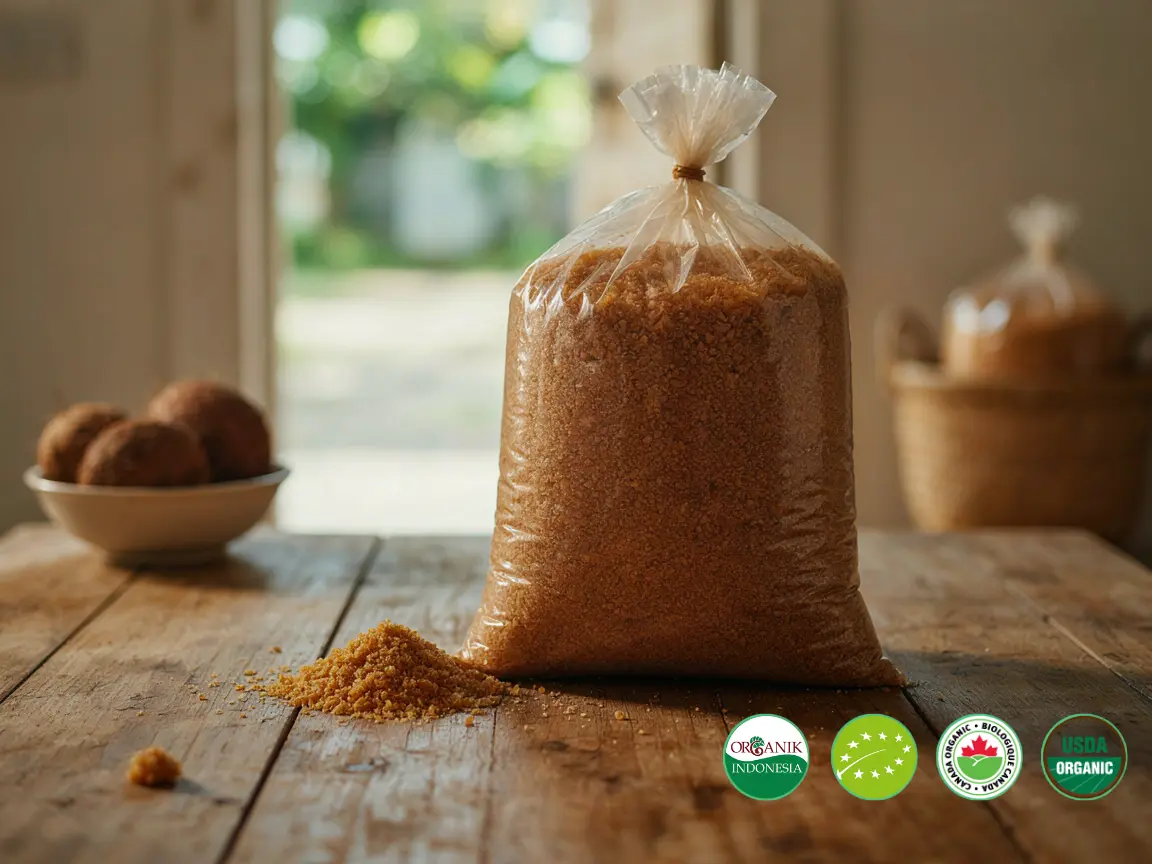
There are two types of coconut sugar. They are made in a similar way. The main difference is certification. Organic coconut sugar needs an organic certificate, such as USDA Organic, EU Organic, Canada Organic, or Indonesia Organic. While natural coconut sugar does not need an organic certificate.
Choose based on your target market and customers. If your buyers expect an organic label, you must have the right certification.
2. Granule Size (Mesh Size)
Mesh size means how fine or coarse the sugar granules are. It affects how the sugar dissolves, blends, and flows through machines.
Finer granules dissolve faster, which is helpful for drinks and baking mixes. Coarser granules can be better for toppings or table use. If you use the sugar in a factory process, tell your coconut sugar manufacturer to adjust the granule.
3. Packaging Format
For bulk orders, common packaging includes:
20 kg and 25 kg
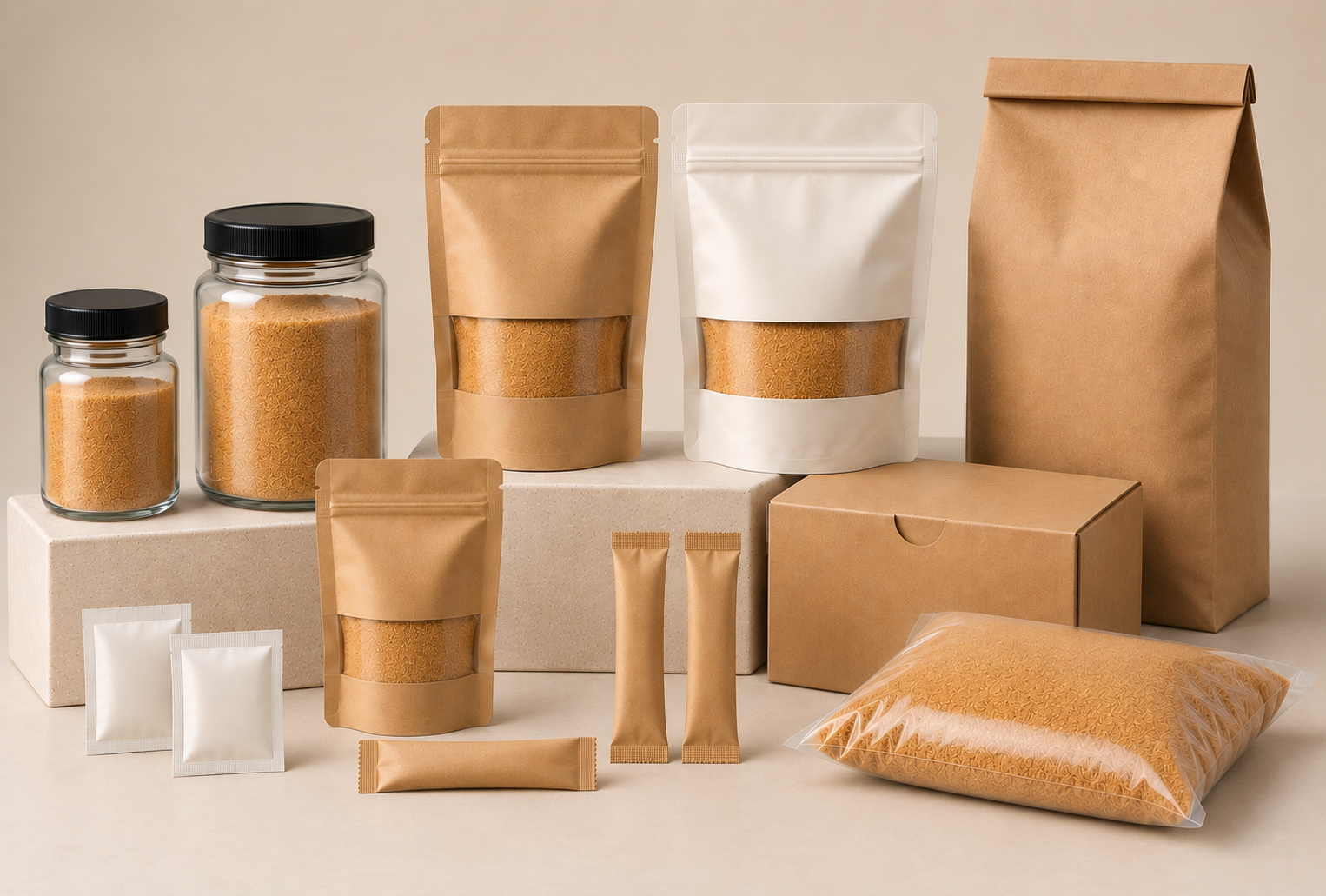
If you plan to sell to consumers, ask whether smaller or retail-ready packaging is possible. Some makers can also support formats such as standing pouches, stick sachets, and jars or bottles, especially when product development is included.
4. Label Design
Your label must follow the rules of the country where you sell. Rules about ingredients, language, and claims are different in every market. A good private label supplier can print buyer-specific labels and help you adjust them to the import regulations of your destination country. Still, you should check your local rules yourself or ask a local expert.
5. Product Forms
Some brands want more than plain granulated sugar. If you make drinks or ready-to-use products, ask whether the manufacturer can also develop coconut sugar-based ingredients in liquid, powder, or block form. This is useful if you want a unique product, not just a standard one.
How the Private Label Process Works, Step by Step
The process is simple when you know the steps:
Inquiry → Specification → Sample → Approval → Production → Quality check → Shipping
Inquiry: You contact the manufacturer and share your needs.
Specification: You agree on product type, mesh size, packaging, and label.
Sample: The manufacturer sends a sample for you to test.
Approval: You approve the sample in writing.
Production: The manufacturer produces your order.
Quality check: The batch is tested before shipping.
Shipping: The goods and documents are sent to you.
The time for each step depends on order size, packaging, label approval, and shipping route. So, it is better for you to ask the manufacturer for the real schedule before you commit.
What to Prepare Before You Contact a Maker
To get faster and accurate information, you need to prepare these details:
Your target market (country or region)
Your expected volume (per order and per year)
The certifications you need (organic or others)
Your packaging idea
How you will use the sugar (drinks, baking, retail, etc.)
1. Sample and Approval
Never skip the sample. Test it for taste, color, moisture, and granule size, and compare it with the specification sheet. Once you approve it, use that sample as your reference. Your first bulk shipment should match it.
2. Shipping and Documents
Ask which documents come with each shipment. The most common documents for international buyers are:
COA (Certificate of Analysis), lab results for product batch
Certificates, organic or food safety certificates that match your product
Incoterms: terms such as FOB or CIF that explain who pays for and handles each part of shipping
FDA Prior Notice filed for US-bound shipments
MOQ, Pricing, and Payment: What Affects the Cost?
MOQ means minimum order quantity. It is the smallest amount a manufacturer will produce in one order. A flexible MOQ is very helpful for new brands, because you can start small and grow the brand.
There is no single price for private label coconut sugar. The final cost depends on several factors. Here are the main things that change your price:
Organic or natural: organic usually costs more because of certification and farming requirements
Packaging type: custom or retail packaging costs more than standard bulk
Mesh size: special sizes may need extra processing, it depends on each manufacturer
Label printing: custom labels add cost
Order volume: larger orders usually get better unit prices
Shipping terms: FOB, CIF, and other terms change the final cost
Be careful with a price that is much lower than others. It can mean mixed sugar, weak quality control, or hidden costs later. A fair price from a transparent maker is usually safer in the long run.
Certifications and Labeling Rules by Market
Different markets may have different requirements. For example, an organic product intended for the United States may need USDA Organic certification, while an organic product for the European market may require EU Organic certification. But a certificate only helps if it is real, so always verify it.
Here’re some things you need to do while verify the certification:
Check the certificate number, scope, and expiry date
Make sure the company name and facility match the maker you are buying from
Confirm it with the certifying body or its official database
Organic markets often ask for specific certificates:
USDA Organic (United States)
EU Organic (European Union)
Canada Organic
Indonesia Organic
Besides organic, ask about food safety documents such as HACCP or GMP, and a COA for each batch.
How to Choose a Private Label Coconut Sugar Manufacturer
Not every coconut sugar supplier is a manufacturer and not all manufacturers have capability in private label coconut sugar. If you are looking for coconut sugar manufacturer for private label, make sure these things:
Are they real factory or trading company. You can ask for a factory visit, audit, or video tour.
A manufacturer that directly collaborate with farmers usually have fresher raw material and more consistent quality.
Can you follow a batch from farm to finished product? A digital system is better than only paper records.
Independent lab testing. Results from an accredited outside lab are more trusted than in-house tests alone.
Capacity and consistency. Ask whether the maker can deliver the same quality in month 12 as in month 1, even when your volume grows or nectar supply changes with the seasons.
Sample vs bulk. The bulk shipment should match the approved sample.
Documentation speed. Fast, complete paperwork is a sign of a strong internal system.
Communication. Clear, quick answers before the sale usually mean good service after it.
For a deeper guide, read Coconut Sugar Manufacturers: A B2B Buyer's Guide.
How Javelo Supports Private Label Orders
Javelo is a coconut sugar manufacturer and supplier in Indonesia. We offer custom packaging or private label for coconut sugar. For private label buyers, we offer:
Bulk and custom packaging with buyer-specific labels, tailored to the import regulations of the destination country. We provide coconut sugar in a carton box (20 kg), paper sack (25 kg), sachet, standing pouch, stick pack, jar, and bottle.
Custom mesh sizes and flexible MOQ, based on buyer needs
Direct sourcing from farmers we support, for fresh raw material and consistent quality
Javelo360 traceability, so clients can check the production date and lab results by batch code
Product development support if you want coconut sugar-based ingredients in liquid, powder, or block form
Ready to Launch Your Own Coconut Sugar Brand?
Whether you need bulk coconut sugar, private label retail products, or a customized coconut-based product, Javelo can be a great business partner for your brand.
Tell us your target market, volume, and packaging idea, and we will help you plan the next step. Request a quote or explore our organic coconut sugar range.